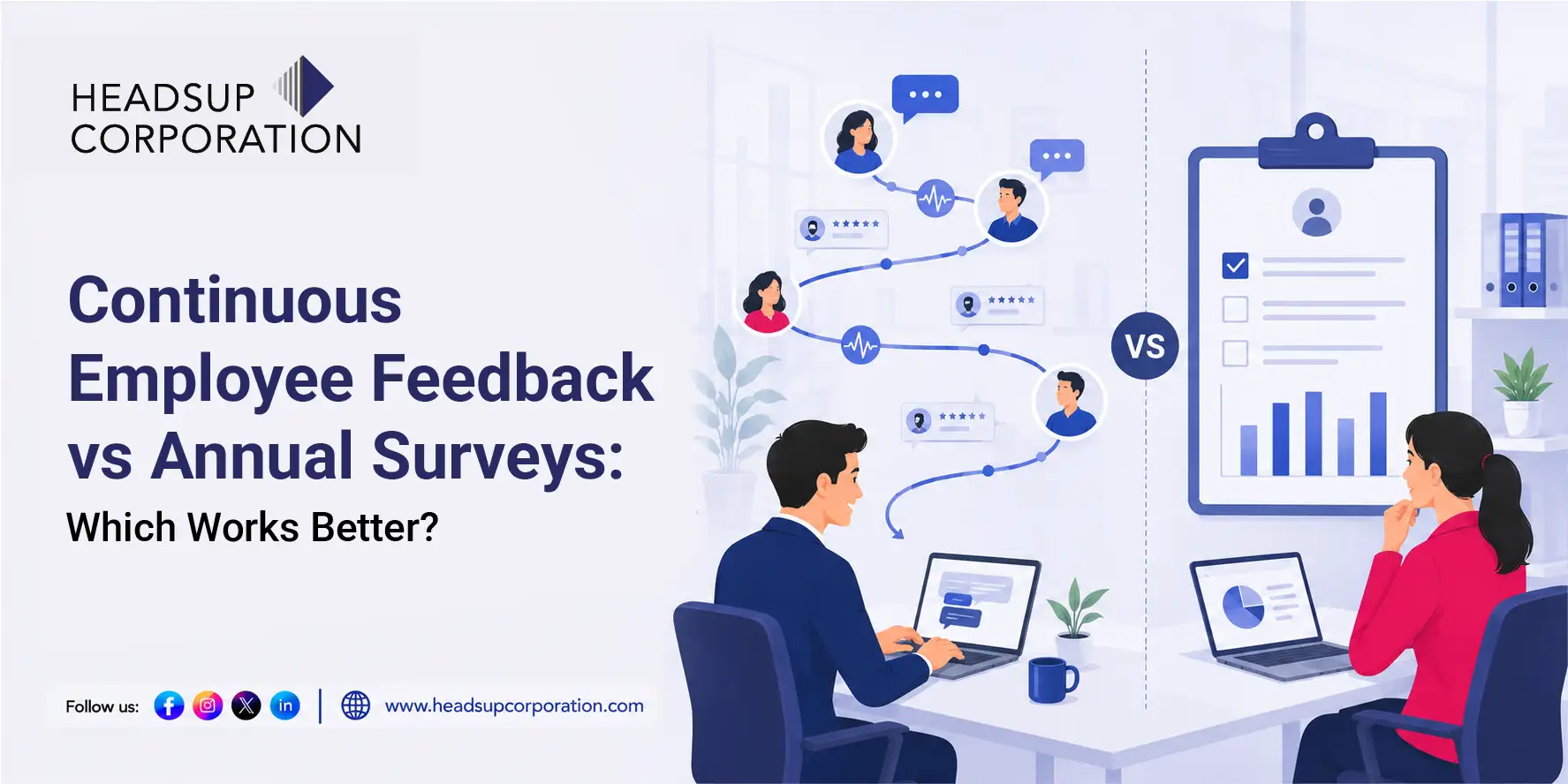
Continuous Employee Feedback vs Annual Surveys: Which Works Better?
For decades, the annual engagement survey was the default way companies measured how employees felt about their jobs. It’s a familiar ritual: one long questionnaire, once a year, followed by a slow rollout of results. But as work has become faster-moving and more distributed, a growing number of organizations are asking whether that model still makes sense, and increasingly, the answer is continuous employee feedback.
The Case for Annual Surveys
Annual surveys aren’t without value. They offer a comprehensive, standardized snapshot that’s easy to benchmark year over year, and their infrequency means they don’t create survey fatigue. For some organizational metrics, long-term culture shifts, compensation satisfaction, big-picture strategic alignment, an annual cadence can be perfectly appropriate. The trouble is when annual surveys become the only feedback mechanism. A once-a-year check-in means problems can fester for months before anyone measures them, and by the time results are analyzed and shared, the conditions that caused low scores may have already changed, or gotten worse.
The Case for Continuous Listening
Continuous listening, frequent, lightweight pulse checks combined with always-on feedback channels, solves the timing problem. Instead of waiting twelve months to learn that a team’s workload has become unsustainable, a manager can see that signal within weeks and respond before it turns into attrition. Continuous feedback also tends to produce more honest, specific input. Shorter, more frequent surveys ask fewer questions at a time, which reduces fatigue and encourages more thoughtful responses rather than rushed box-ticking on a 60-question annual form.
Comparing the Two Approaches
| Annual Surveys | Continuous Feedback | |
| Frequency | Once a year | Weekly, biweekly, or monthly |
| Depth | Comprehensive, broad | Focused, specific |
| Speed to insight | Slow (months) | Fast (days to weeks) |
| Risk of fatigue | Low | Moderate, if overused |
| Best for | Strategic, long-term trends | Early warning signals, day-to-day sentiment |
Most organizations moving successfully into continuous listening aren’t abandoning annual surveys entirely; they’re layering the two. An employee feedback survey run annually still provides a useful benchmark and deep-dive on topics too broad for a quick pulse check, while shorter, more frequent surveys catch emerging issues in between. The combination works because each method compensates for the other’s weakness: annual surveys provide depth and consistency; continuous feedback provides speed and responsiveness.
Making the Shift Without Overwhelming Employees
Organizations that move toward continuous feedback sometimes overcorrect and end up surveying employees so often that it backfires. To avoid that:
- Keep pulse surveys short; five questions or fewer is a reasonable target.
- Vary the topics so employees aren’t answering the same question every cycle.
- Make participation clearly worthwhile by visibly acting on results.
- Give employees an always-on channel for feedback that doesn’t need to wait for a scheduled survey.
The debate over continuous feedback versus annual surveys isn’t really about which method is “better” in the abstract; it’s about matching the right cadence to the right kind of insight. Annual surveys still have a place for broad, strategic questions. But for catching problems while they’re still solvable, continuous listening has become the standard that organizations are increasingly expected to meet.