AI Exit Interview Analysis: Using AI to Analyze Feedback at Scale
AI exit interview analysis helps organisations turn large volumes of unstructured employee feedback into meaningful patterns, themes, and actionable insights. Exit interviews generate data that often gets lost in basic reporting. This is especially true when third-party exit interviews are involved, as they can reveal a different and
often more candid story about the employee experience.
Unlike surveys based on tick-boxes and scores, exit interviews produce open-ended, human responses:
“I felt like my contributions weren’t valued.”
“The team dynamic was difficult.”
“I didn’t see a future here.”
These responses are rich with meaning, but they can also be difficult to analyse consistently at scale. For a company conducting 50 exit interviews a year, an HR analyst may be able to review the responses manually. For an organisation handling 500 or more interviews, identifying consistent patterns across hundreds of
conversations becomes considerably more difficult.
This is where AI-powered exit interview analysis can become genuinely useful.
What Is AI Exit Interview Analysis?
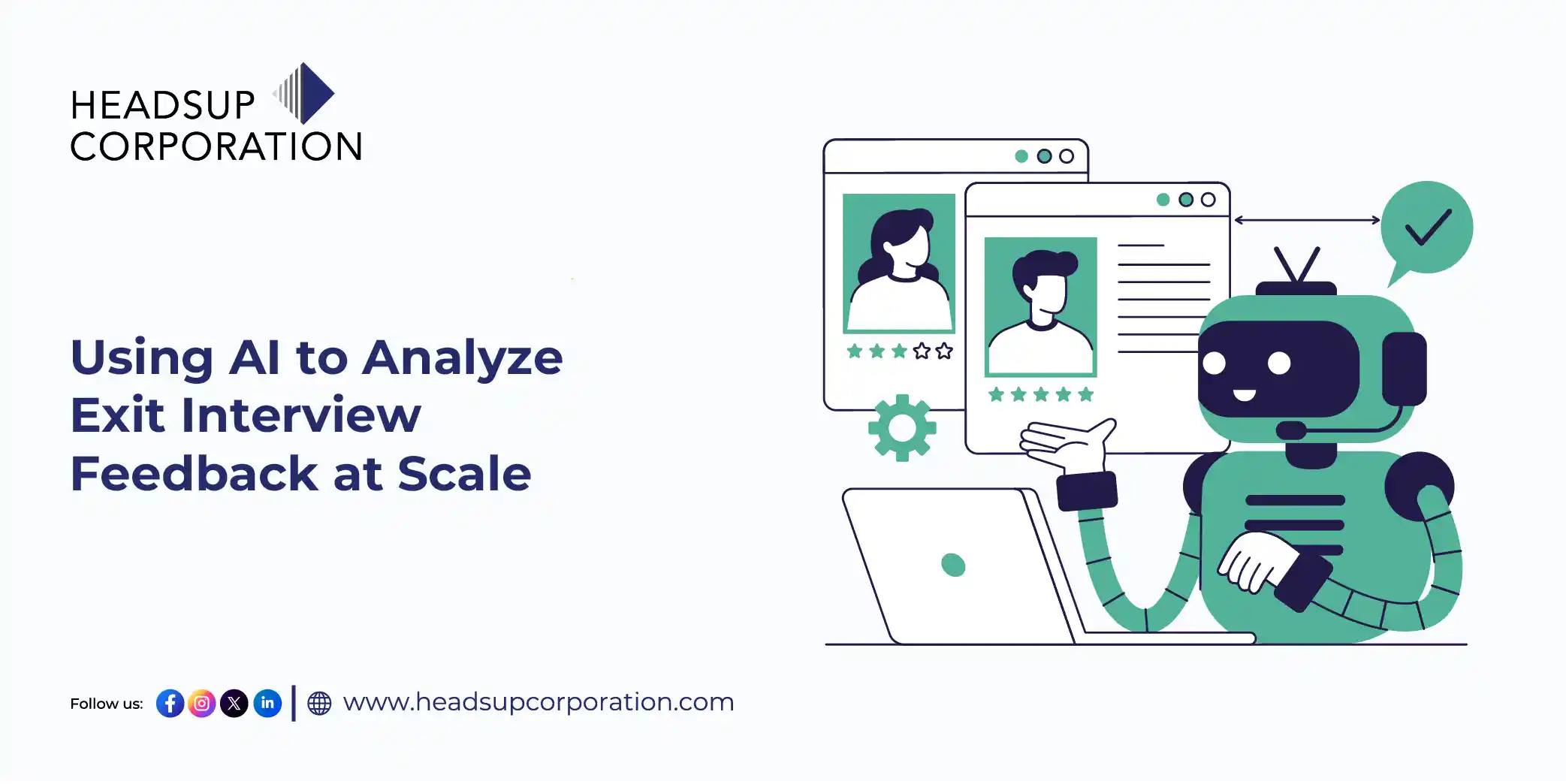
AI exit interview analysis uses artificial intelligence to process and analyse qualitative employee feedback from exit interviews. Instead of requiring HR teams to manually read every response and identify recurring themes, AI can process large volumes of text and highlight patterns across interviews.
Depending on the technology being used, AI can help with sentiment analysis, theme detection and clustering, pattern identification, recurring issue detection, trend analysis, anomaly detection, root-cause identification, and comparative analysis across departments or employee groups.
The goal isn’t to replace HR judgment. The goal is to help HR teams move from manually reading feedback to systematically understanding what the feedback is saying.
What AI Can Actually Do With Exit Feedback
Let’s be specific here, because ‘using AI’ can mean a lot of things. In the context of exit interview analysis, the most practical applications are sentiment analysis, theme clustering, and anomaly detection. Sentiment analysis means the system can read a block of text and determine whether the tone is positive, negative, or neutral, and to what degree.
A response like ‘the work was interesting but the management was really frustrating’ gets broken down into its component sentiments, rather than being treated as a single undifferentiated piece of feedback.
Theme clustering is, arguably, more valuable. The system identifies conceptually similar responses across hundreds of interviews and groups them together. ‘My manager never gave feedback’ and ‘I never knew where I stood with my team lead’ may be phrased completely differently, but they cluster around the same root issue. That’s a connection a human analyst might make after hours of reading. An AI system can surface it in minutes.
Anomaly detection flags unusual patterns, a spike in exits from a particular department, a sudden increase in mentions of a specific phrase, or a demographic segment that’s leaving at a rate disproportionate to its size. These are things that might take months to notice manually, and by that point, significant damage may already have been done.
The Honest Limitations
AI-powered analysis is only as good as the data it’s working with. If exit interviews are vague, if employees are giving non-committal answers because they’re worried about confidentiality, then the AI will cluster vague themes and produce vague insights. Garbage in, garbage out, as the saying goes. There’s also the question of context. An AI might correctly identify that ‘lack of recognition’ is a recurring theme in a particular team. But it can’t necessarily tell you whether that’s because of one manager’s style, a structural absence of recognition programmes, or a recent reorg that disrupted team dynamics. A human still needs to interpret the pattern and decide what to do about it.
So the realistic picture is this: AI handles scale and pattern recognition. Humans handle interpretation and action. The two work best together.
What This Looks Like in Practice
An organisation running AI-powered exit analysis might look something like this. Exit interviews are conducted, ideally by a neutral third party, and responses are logged into a central system. The AI processes the text, generates sentiment scores, and surfaces the top five to ten recurring themes each quarter. An HR leader reviews those themes, cross-references them with turnover data and engagement scores, and identifies two or three priority areas for action.
The result isn’t a magic retention solution. It’s a much clearer view of what’s actually happening across the organisation, clearer than any HR team could produce purely through manual reading and intuition. One thing worth noting: the companies that tend to get the most out of this aren’t necessarily the most technically sophisticated. They’re the ones that have committed to actually acting on what the data tells them. Analysis without action is just an expensive way to confirm your worst suspicions.
Starting With AI Analysis
You don’t need to build something custom to start. Several HR platforms now offer built-in text analysis for exit and engagement feedback. The more important foundational step is ensuring your exit interviews are structured enough, and candid enough, to generate useful input data in the first place. That’s the part that AI can’t fix for you.
At Headsup Corporation, we bridge the gap between raw exit interview data and the insights HR leaders actually need. Our exit interview process is specifically designed to generate the quality of response that makes AI-powered analysis meaningful, candid, detailed, and structured around themes that matter.
We work with mid-to-large organisations across India to implement scalable exit intelligence programmes, combining third-party interview methodology with technology-assisted theme analysis. You get quarterly reports that surface the patterns driving your attrition, along with practical recommendations grounded in your specific organisational context. If your company is at the stage where exit feedback is piling up unread, or where you suspect there are systemic issues you’re not quite seeing, Headsup can help you find the signal in the noise.
Also Read:
- What is an Exit Interview?
- Benefits of Exit Interviews for Employees
- How to Conduct Effective Exit Interviews
- Exit Interview Data Analysis Process
- Exit Interview Trends in 2026
Analyse Exit Interview Feedback With AI
Want to analyse exit interview feedback using AI? Headsup Corporation’s Milestones helps organisations turn exit interview data into structured insights by identifying patterns, trends, and potential root causes across employee feedback. 👉 Try Milestones Today