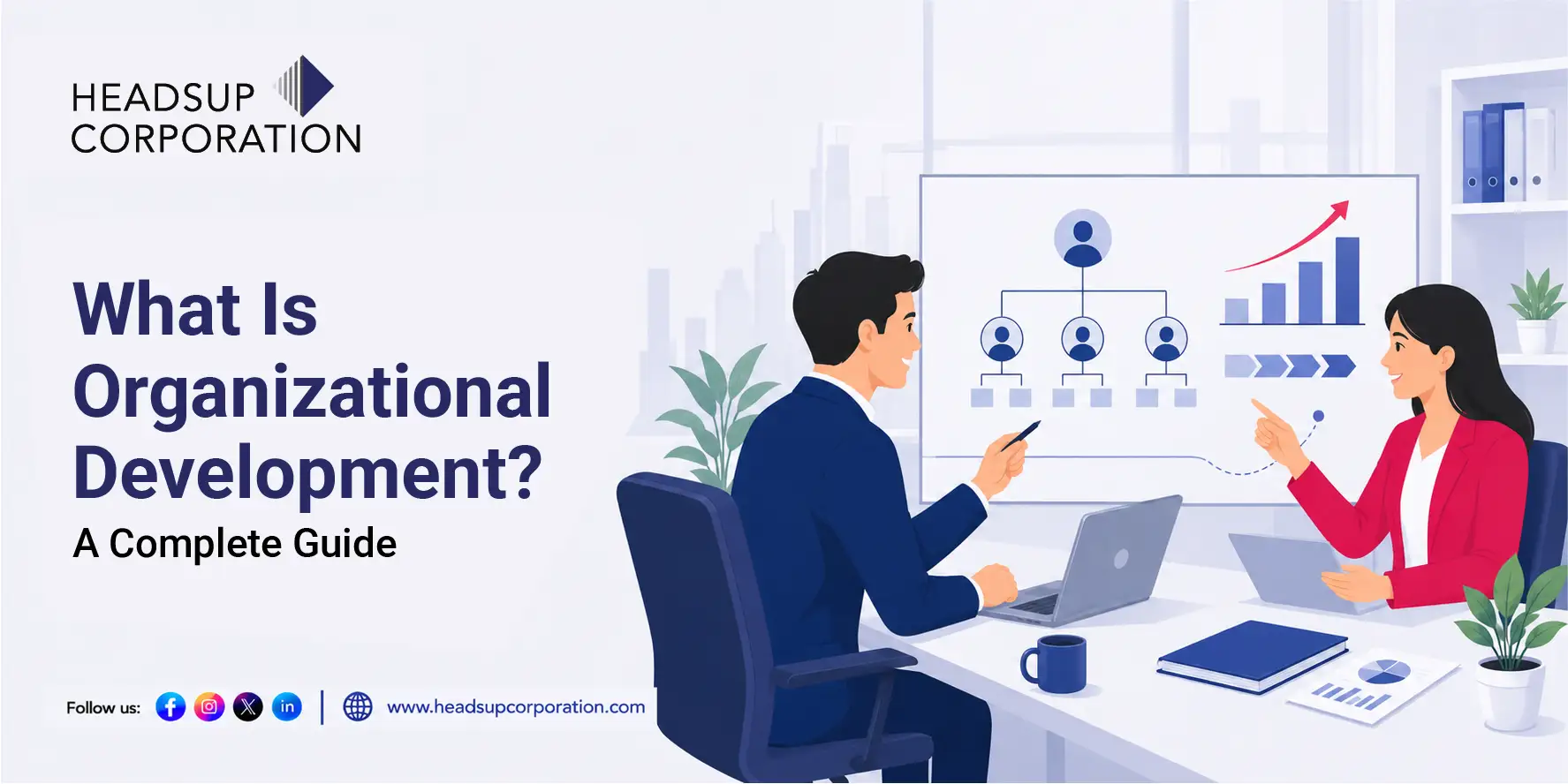
What Is Organisational Development? A Complete Guide
People say terms like “organisational development” and “HR” like they’re the same thing. They’re not, and the difference actually matters if you’re trying to fix something structural in your company rather than just administer it. Let’s get into what OD actually is.
What is organisational development?
Organisational development, or OD, is a planned, evidence-based approach to improving how an organisation functions, its structure, processes, culture, and capability, usually through deliberate interventions rather than one-off fixes. It’s rooted in behavioural science, which is why it looks less like policy-writing and more like diagnosis: understanding why a team, department, or company isn’t performing the way it should, then designing a targeted change to fix the underlying cause.
Goals of organisational development
OD isn’t trying to solve a single problem; it’s trying to build durable capability. In practice, that usually means: improving organisational effectiveness and adaptability, strengthening leadership and communication, aligning culture with strategy, and building the organisation’s capacity to handle change without falling apart every time something shifts. Change Synergy research found less than a third of employees say their organisation even factors their ability to adapt to change into development planning, which is precisely the gap OD is meant to close.
Organisational development vs. Human Resources
HR runs the operational machinery: payroll, hiring, compliance, performance reviews. OD sits above that, focused on systemic change: why is this department constantly in conflict, why does this merger keep stalling, why does leadership keep losing people six months after promotion. HR keeps the organisation running day to day. OD asks whether the organisation, as designed, actually works, and if not, redesigns it.
Examples of OD interventions
OD interventions generally fall into a few buckets:
- Human process interventions, focused on interpersonal relations, group dynamics, and communication, often team-building workshops or conflict mediation between departments.
- Techno-structural interventions, targeting structural and technological issues, including organisational design and work redesign.
- Human resource management interventions, covering performance management, talent development, and workplace wellbeing.
- Strategic change interventions, including transformational change, restructuring, or merging two organisations.
Stages of organisational development
Most OD work follows a version of: entry and diagnosis (understanding what’s actually broken), planning the intervention, implementation, and evaluation, followed by institutionalising whatever worked so it doesn’t quietly unravel six months later. The evaluation stage is the one companies skip most often, which is a mistake. Prosci found that 88% of businesses with excellent change management practices met or exceeded their objectives, compared to just 13% of those with poor change management. That gap is almost entirely about whether anyone measured and adjusted along the way.
Organisational development process, in practice
Start with data, not assumptions: exit interviews, engagement surveys, performance patterns, leadership feedback. Diagnose the actual root cause (a “communication problem” is often really a structural one, two teams with overlapping mandates and no clear decision owner). Design the intervention to match that root cause specifically, pilot it in one function before rolling out company-wide, and build in a review checkpoint at 90 days.
Real-life organisational development examples
A mid-size company noticing high attrition specifically among managers might run a human process intervention, leadership coaching and structured feedback loops, rather than assuming it’s a compensation problem. A company post-merger with two departments duplicating work might run a strategic change intervention to redesign reporting lines and decision rights before the duplication becomes cultural resentment.
Organisational development skills
Strong OD practitioners combine diagnostic skills (reading data and behaviour patterns accurately), facilitation (running workshops and mediating conflict without taking sides), change management, and enough business fluency to tie interventions back to revenue or growth outcomes, not just “culture.”
Organisational development certification
There’s no single mandatory certification, but recognised options include the OD Certified Professional (ODCP), certifications through AIHR, and broader change management credentials like Prosci. For Indian HR professionals, pairing an OD certification with practical exposure to Indian compliance contexts (Labour Codes, POSH/ICC structures) makes the credential far more applicable day-to-day.
How Headsup Corporation approaches organisational development
We run OD diagnostics for Indian growth-stage companies facing a specific, named problem: high manager attrition, post-restructuring friction, culture that hasn’t kept pace with rapid hiring. Our approach starts with data, not a generic culture workshop, and every intervention we design is built to be measured at 90 days, not just implemented and forgotten.
Facing a specific structural problem- high manager attrition, post-merger friction, culture strain from fast hiring? Headsup Corporation runs data-driven OD diagnostics for Indian companies; reach out to talk through what’s actually going on.